
How Much Income Can Your Mississippi Deferred Compensation 457(b) Account Generate in Retirement?
If you’re a Mississippi public employee approaching retirement, one of the most important questions is: How much income can your deferred compensation 457 account generate?
The answer depends on your account balance, retirement age, investment returns, inflation, and how long you need the money to last.
For Mississippi PERS members, deferred comp may serve as:
A bridge until Social Security begins
A way to pay for state retiree health insurance premiums until Medicare begins
A source of lifelong supplemental income
What Drives Your Income Higher?
Monthly income from deferred comp generally increases when:
Your account balance is higher
Your withdrawal period is shorter
Your investment returns are higher
Inflation is lower
For example, someone retiring from PERS at age 50 and using deferred comp as an income bridge to age 62 must spread withdrawals across 12 years. Contrast this with someone retiring from PERS at age 60 who only needs the account to last two years until they turn 62. The same account balance can produce dramatically different monthly incomes.
To help Mississippi PERS members visualize what their monthly income potential is in retirement we modeled monthly, annual, and lifetime income across a range of deferred compensation balances at retirement and for various withdrawal duration periods.
Assumptions Used in Our Model
Our analysis used the following assumptions:
Investment option: Vanguard Target Retirement Income Fund (VTINX)
Nominal return: 5.5%
Inflation rate: 2.5%
Real return: 3% (purchasing power)
Withdrawals: Monthly on the 1st of the month, beginning immediately after retirement
These assumptions are for illustrative purposes only. Your actual results may vary based on market performance, investment allocation, fees, taxes, inflation, and withdrawal decisions.
Using Deferred Comp as Bridge Until Age 62
Suppose a retiree wants to withdraw funds from their deferred comp account as an income bridge until the retiree begins to claim Social Security at age 62. Here is what their monthly, annual, and lifetime retirement income adjusted for inflation could look like through age 61 based on various deferred comp account balances at retirement and various ages at which the the individual begins drawing from their deferred comp account:
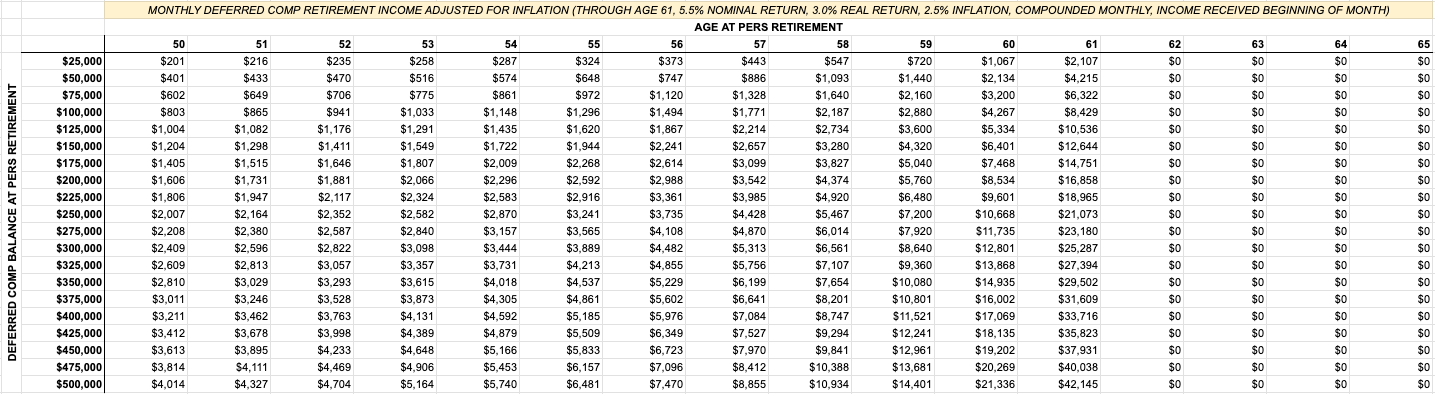
Monthly Income Adjusted for Inflation Through Age 61
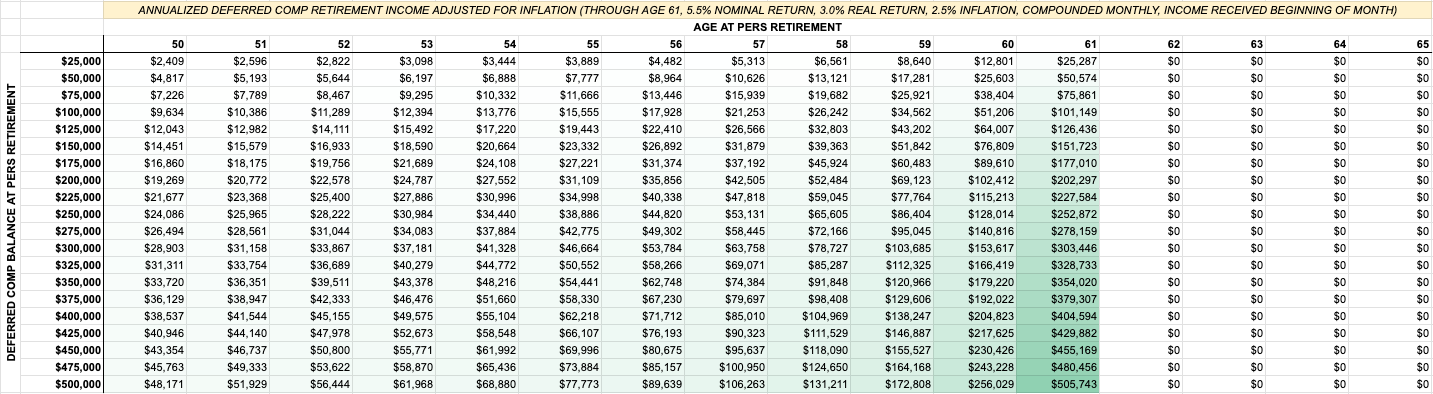
Annual Income Adjusted for Inflation Through Age 61
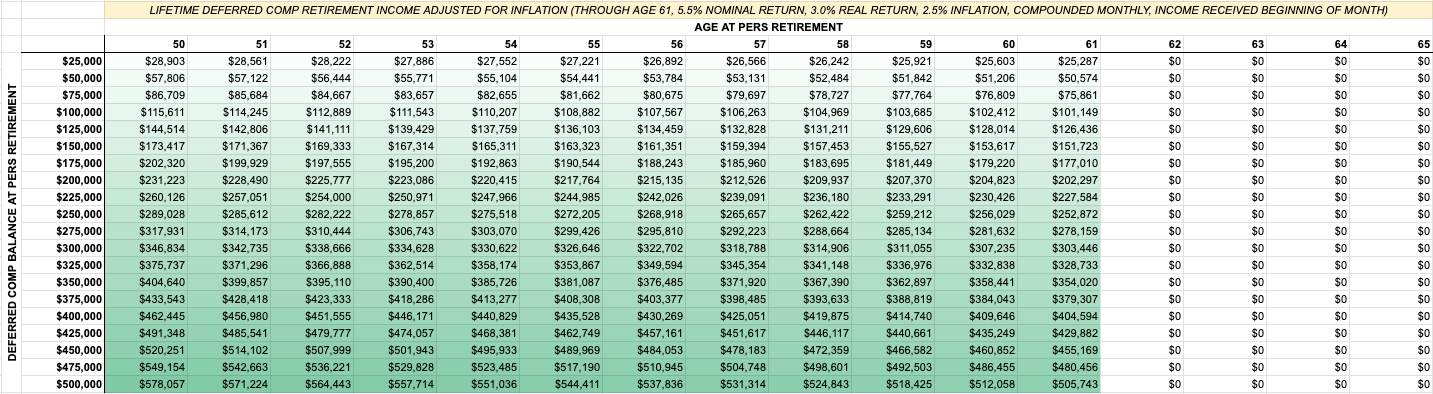
Lifetime Income Adjusted for Inflation Through Age 61
A $250,000 balance could generate approximately:
Starting at age 50 through age 61:
$2,007 per month
$24,086 per year
$289,028 lifetime
Starting at age 55 through age 61:
$3,241 per month
$38,886 per year
$272,205 lifetime
Starting at age 60 through age 61:
$10,668 per month
$128,014 per year
$256,029 lifetime
The shorter the withdrawal period, the higher the monthly payment. However, a shorter period means less time for the deferred comp account to grow and less total lifetime retirement income.
Using Deferred Comp as Bridge Until Age 65
Suppose a retiree wants to withdraw funds from their deferred comp account as an income bridge until the retiree is eligible for Medicare and begins to claim Social Security at age 65. Here is what their monthly, annual, and lifetime retirement income adjusted for inflation could look like through age 64 based on various deferred comp account balances at retirement and various ages at which the the individual begins drawing from their deferred comp account:
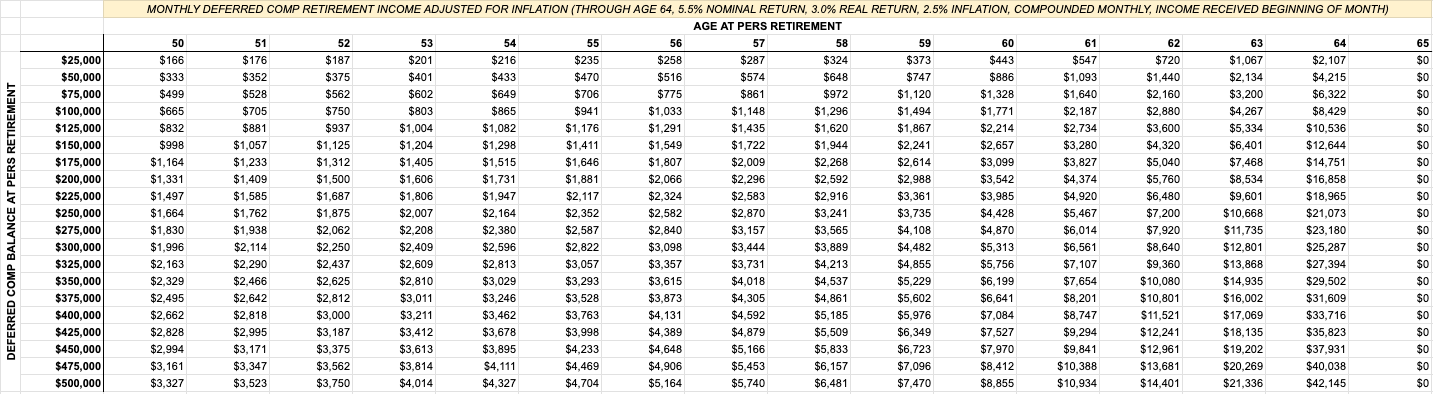
Monthly Income Adjusted for Inflation Through Age 64
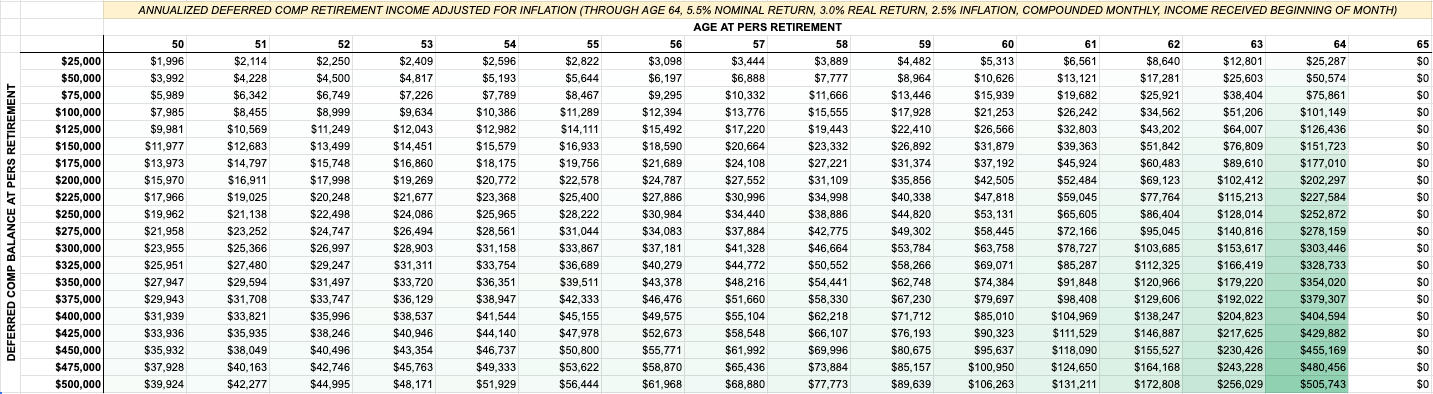
Annual Income Adjusted for Inflation Through Age 64
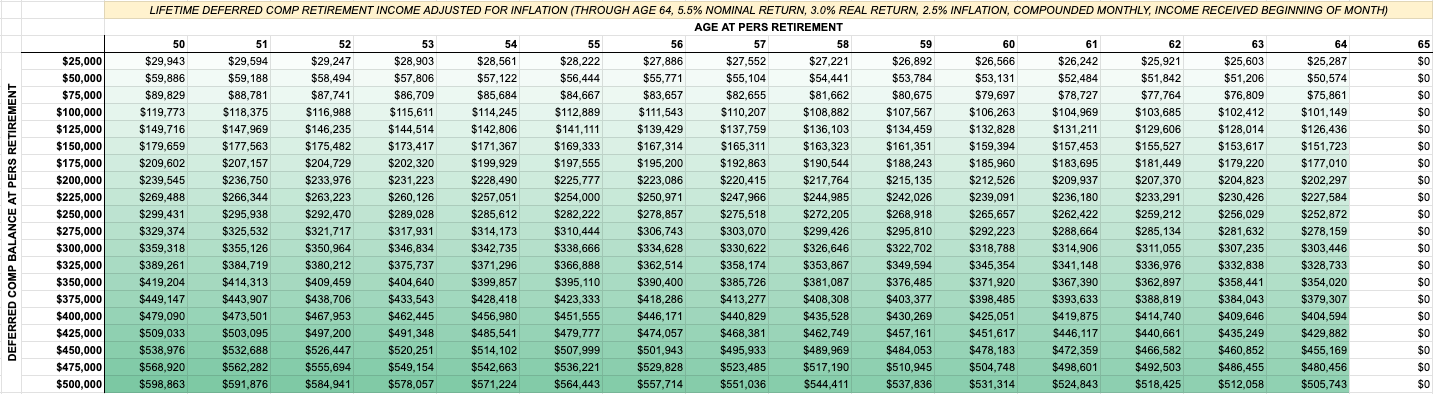
Lifetime Income Adjusted for Inflation Through Age 64
A $250,000 balance could generate approximately:
Starting at age 50 through age 64:
$1,664 per month
$19,962 per year
$299,431 lifetime
Starting at age 55 through age 64:
$2,352 per month
$28,222 per year
$282,222 lifetime
Starting at age 60 through age 64:
$4,428 per month
$53,131 per year
$265,657 lifetime
Because the account must last longer than in the age 62 scenario, the monthly and annual income is lower. However, because of the increased withdrawal period, the account has longer to grow leading to higher lifetime income for the age 65 scenario compared to the age 62 scenario.
Using Deferred Comp as Bridge Until Age 70
Suppose a retiree wants to withdraw funds from their deferred comp account as an income bridge until the retiree can no longer delay Social Security at age 70. Here is what their monthly, annual, and lifetime retirement income adjusted for inflation could look like through age 69 based on various deferred comp account balances at retirement and various ages at which the the individual begins drawing from their deferred comp account:
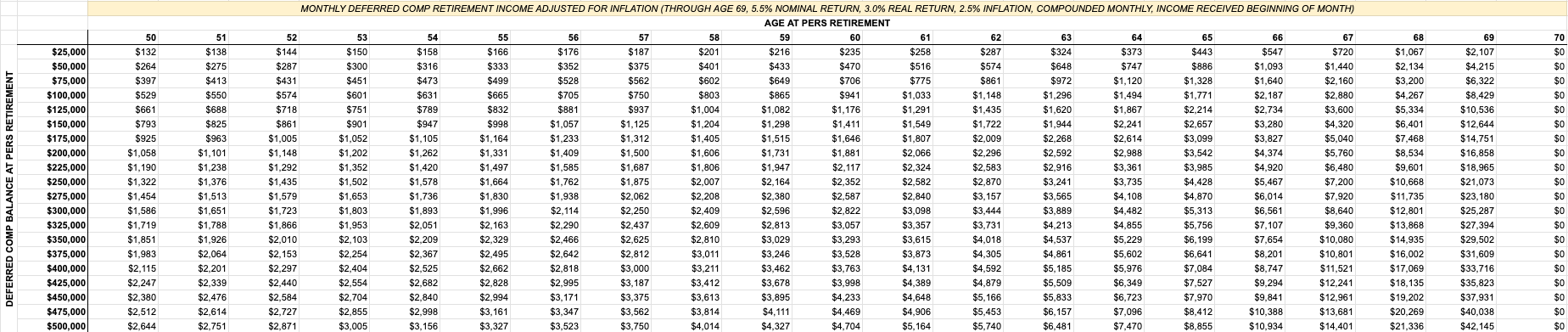
Monthly Income Adjusted for Inflation Through Age 69
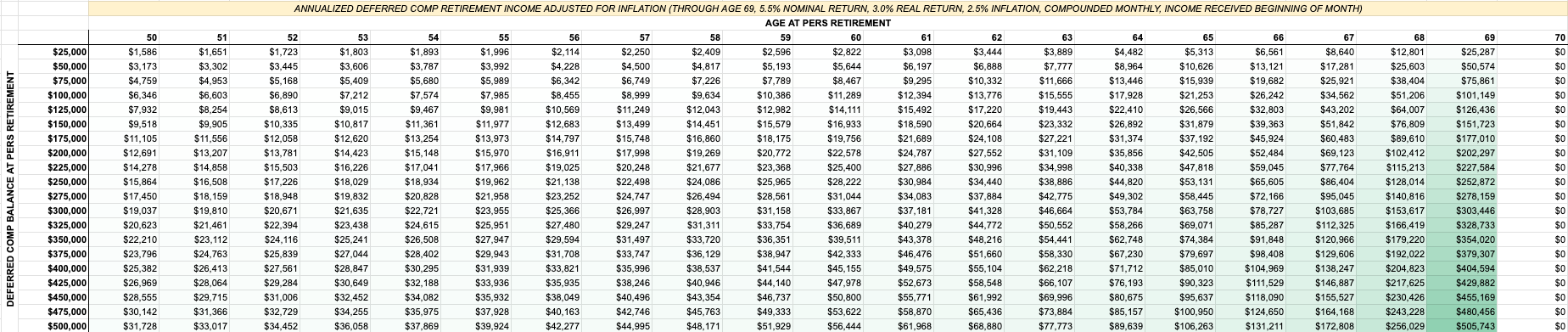
Annual Income Adjusted for Inflation Through Age 69
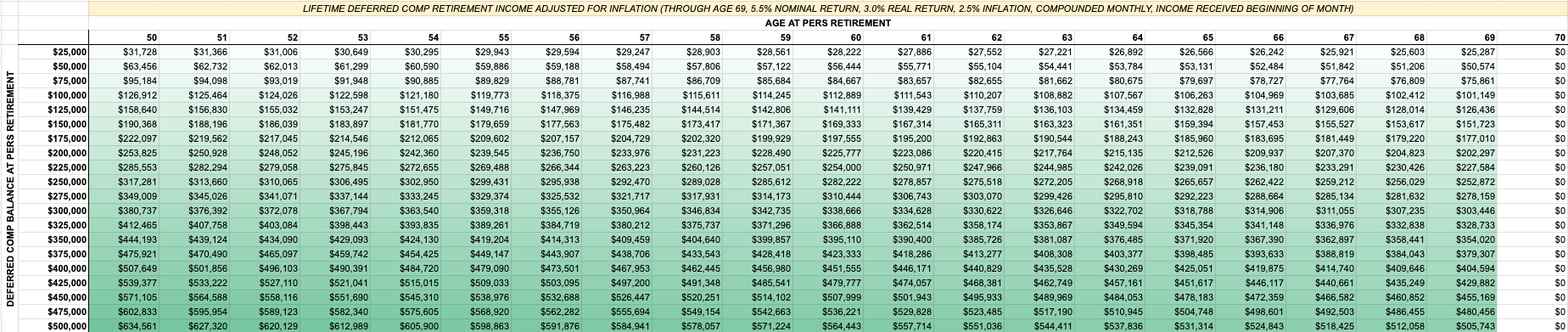
Lifetime Income Adjusted for Inflation Through Age 69
A $250,000 balance could generate approximately:
Starting at age 50 through age 69:
$1,322 per month
$15,864 per year
$317,281 lifetime
Starting at age 55 through age 69:
$1,664 per month
$19,962 per year
$299,431 lifetime
Starting at age 60 through age 69:
$2,352 per month
$28,222 per year
$282,222 lifetime
Starting at age 65 through age 69:
$4,428 per month
$53,131 per year
$265,657 lifetime
Because the account must last longer than in the age 62 or age 65 scenario, the monthly and annual income is lower. However, because of the increased withdrawal period, the account has longer to grow leading to higher lifetime income for the age 70 scenario compared to the age 62 or age 65 scenario.
Using Deferred Comp as Lifelong Income Supplement Until Age 85
Suppose a retiree wants to withdraw funds from their deferred comp account as a steady lifelong supplemental income. Here is what their monthly, annual, and lifetime retirement income adjusted for inflation could look like through age 85 based on various deferred comp account balances at retirement and various ages at which the the individual begins drawing from their deferred comp account:
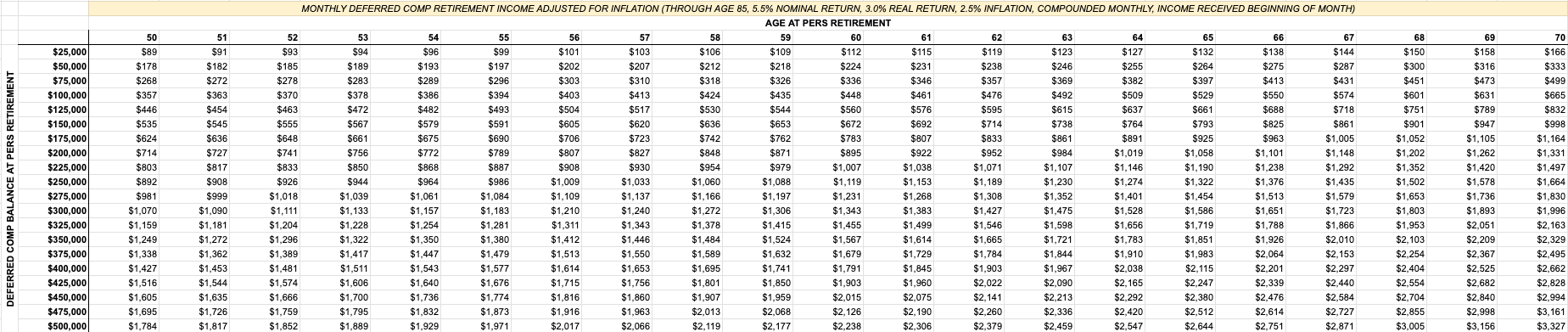
Monthly Income Adjusted for Inflation Through Age 85
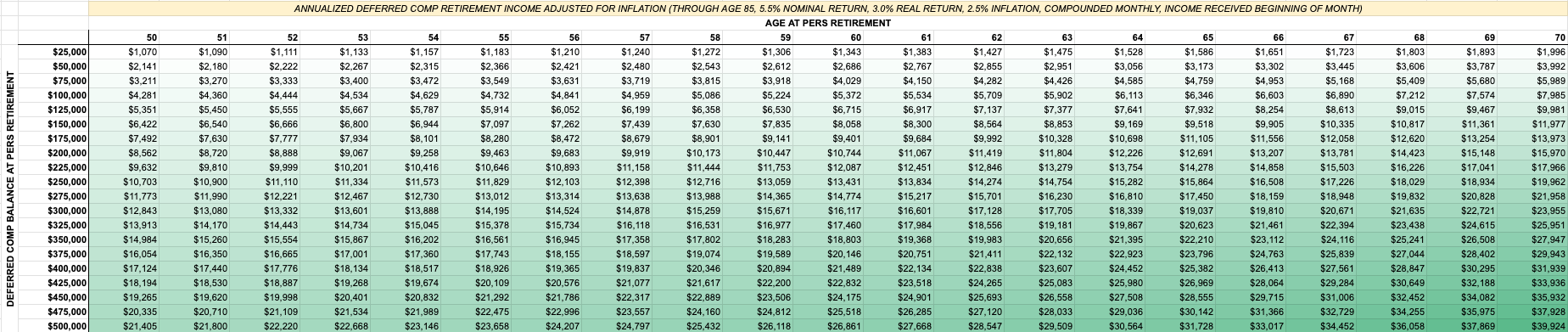
Annual Income Adjusted for Inflation Through Age 85
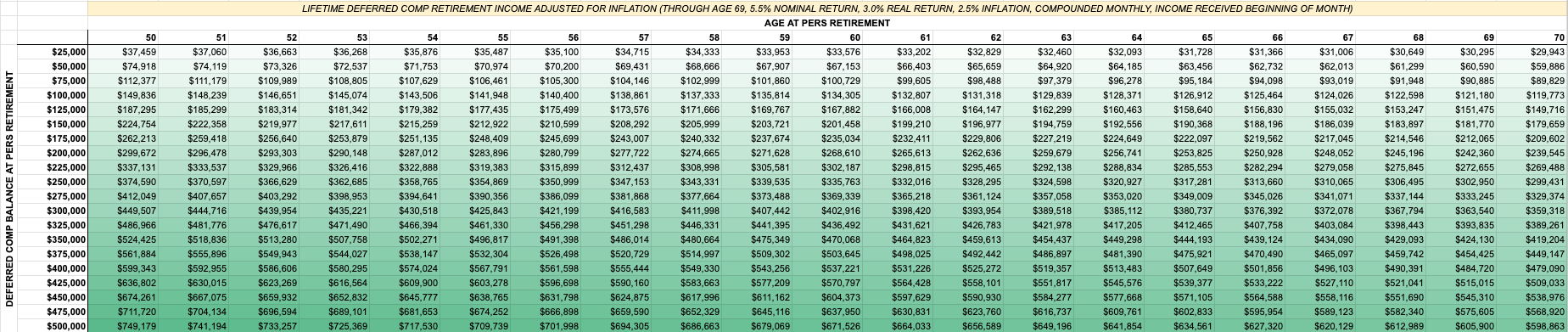
Lifetime Income Adjusted for Inflation Through Age 85
A $250,000 balance could generate approximately:
Starting at age 50 through age 85:
$892 per month
$10,703 per year
$374,590 lifetime
Starting at age 55 through age 85:
$986 per month
$11,829 per year
$354,869 lifetime
Starting at age 60 through age 85:
$1,119 per month
$13,431 per year
$335,763 lifetime
Starting at age 65 through age 85:
$1,322 per month
$15,864 per year
$317,281 lifetime
Starting at age 70 through age 85:
$1,664 per month
$19,962 per year
$299,431 lifetime
Because the account must last longer than in the age 62, 65, or 70 scenario, the monthly and annual income is lower. However, because of the increased withdrawal period, the account has longer to grow leading to higher lifetime income for the age 85 scenario compared to the age 62, 65, or 70 scenario.
Notice too that the lifetime withdrawal amounts can be upwards of 50% more than the original deferred comp account balance. This can happen due to the growth in the deferred comp account funds that remain while the retiree is drawing down the balance.
What Steps Mississippi PERS Retirees Should Take
Before retirement, consider these three steps:
1. Assign Your Deferred Comp a Role
Decide whether it will be used as an income bridge, on as needed basis, or as lifelong supplemental income.
2. Coordinate Your Income Stack
Start with your monthly PERS pension, add your estimated Social Security benefit, and determine the exact monthly income gap your Deferred Comp account needs to fill and the duration the gap exists.
3. Align Returns and Balance Targets
Work backward from your desired retirement age. Estimating your target monthly income dictates the balance you must accumulate in Deferred Comp prior to retirement. Conversely, if your balance is fixed, setting realistic return assumptions dictates your the monthly draw you can afford.
The earlier you take these actions, the more flexibility you will have.
Frequently Asked Questions (FAQs)
Does the federal 10% early withdrawal penalty apply if I take Deferred Comp before age 59½?
Answer: No, unlike traditional IRAs or 401(k) plans, Governmental 457(b) plans—such as Mississippi Deferred Comp—are exempt from the 10% early withdrawal penalty upon separation from service, regardless of your age. However, withdrawals are still subject to federal income taxes at normal ordinary tax rates.
Are Mississippi Deferred Comp withdrawals subject to state income tax?
Answer: In Mississippi, retirement income distributions—including PERS pensions, Social Security, and distributions from qualified retirement plans like the 457 Deferred Comp plan—are 100% exempt from Mississippi state income tax for state residents assuming retirement plan requirements are met.
Can I change my monthly withdrawal amount after I start taking payouts?
Answer: Yes, the Mississippi Deferred Comp plan allows participants to adjust their distribution frequency and payout amounts, take partial lump sums, or temporarily pause distributions as their financial needs change in retirement.
How do Required Minimum Distributions (RMDs) affect my Mississippi Deferred Comp plan in retirement?
Answer: Starting at age 73, IRS rules dictate that you must begin taking Required Minimum Distributions (RMDs) from your pre-tax Deferred Comp account. If your planned monthly withdrawals already exceed the IRS calculated minimum annual amount, you satisfy the rule automatically. However, if you are drawing a lower supplemental amount, your annual payout may need to increase slightly to meet IRS minimum distribution mandates and avoid penalties.
Can I roll over outside 401(k), 403(b), or IRA funds into my Mississippi Deferred Comp account?
Answer: Yes, active state employees and PERS members can roll eligible pre-tax balances from previous employer plans—including 401(k), 403(b), and IRAs—into the Mississippi Deferred Comp plan. Consolidating outside funds into MDC simplifies the management of your distributions.
Final Thoughts
Your Mississippi PERS pension provides a crucial safety net, but often times your Mississippi Deferred Compensation 457(b) account provides supplemental income for a specified period of time. For Mississippi PERS members, coordinating deferred comp with a pension and Social Security can help create a clearer, more confident path into retirement.
Ready to Build Your Personalized Retirement Plan?
Every PERS member’s situation is unique. If you would like a custom retirement plan coordinating your PERS Pension, Deferred Comp, Social Security income, we invite you to start the conversation.
👉 Click Here to Schedule an Introductory Meeting with Ryan Earley
Official Sources & References:
Vanguard Target Retirement Income Fund (VTINX) Profile: Morningstar VTINX Overview
Vanguard Target Retirement Income Fund (VTINX) Prospectus: Broadridge Prospectus Express
Mississippi Deferred Comp Investments Performance: Retirement Partner IOAG Document
Legal Disclaimer
This blog post is for educational and informational purposes only and should not be construed as individualized financial, legal, or tax advice. Neither the author nor PERS Pro are officially affiliated with, endorsed by, or sponsored by the Public Employees' Retirement System of Mississippi (PERS) or the Mississippi Deferred Compensation Plan. Hypothesized return rates (5.5% nominal, 2.5% inflation) and sample scenarios are purely illustrative and do not guarantee future investment performance. Always consult a qualified financial advisor and tax professional regarding your personal situation prior to making retirement decisions.
