
How a Late-Career Raise Can Increase Your Mississippi PERS Pension
If you’re a Mississippi public employee nearing retirement, a promotion or extra-duty pay increase can permanently raise your monthly PERS pension for life. The size of that boost depends on how long you earn the higher salary before retiring and how many years of service credit you have.
In this post, you’ll learn how late-career salary increases affect your PERS benefit, why the timing matters so much, and how to estimate the monthly pension impact before you decide whether to take on more responsibility late in your career.
How Late-Career Promotions Impact Your PERS Pension
When evaluating a promotion late in your career, the added job responsibilities are immediately apparent—but the long-term benefit to your retirement income isn't always well understood. Under the Mississippi PERS formula for Tier 1–3 members, your monthly pension benefit is calculated using two primary variables:
Total Years of PERS Service Credit: Your total creditable service years including purchased credit.
Average Compensation: The average of your four highest-earning fiscal years of compensation.
Why Late-Career Pay Matters So Much for Mississippi PERS Pensions
Because Average Compensation is calculated over a 48-month window, a higher salary must be earned for four full fiscal years to completely replace your older, lower earnings in your benefit formula. If you retire before holding the promotion for four years, the raise applies only to the fraction of months you actually worked at the new higher pay rate.
Here are general rules of thumb:
4 or more years at the higher pay - 100% of the raise is reflected in the highest four average compensation.
3 years - about 75% is captured.
2 years - about 50% is captured.
1 year - about 25% is captured.
That means if you wait until the final year of work to take on a higher-paying role, you still gain something - but not nearly as much as someone who holds that salary for several years.
Key Insight:
Thelonger you hold the higher salary before retiring, the more of that raise gets included in your pension formula.
How Your Years of Service Credit Still Matters With Raises
Another reason this topic matters is that the pension boost is not the same for everyone even for those with the same raise amount. Your years of service credit affect how much your pension responds to a salary increase.
The same raise creates a bigger monthly increase for someone retiring with 40 years of service credit than for someone retiring with 25 years. That’s because the pension formula scales with service credit.
So if two employees receive the same promotion late in their careers, the one with more service credit will see a larger monthly pension increase. To summarize, when trying to optimize a raise or promotion late in your career you need to consider:
How much the raise is
How many years you’ll work at that higher pay
How much service credit you’ll have when you retire
The Results: PERS Monthly Pension Increases
So how can a raise be quantified in PERS pension terms? You can isolate the raise itself and use it as the highest four average compensation variable in the PERS benefit formula and combine that with the number of years the raise is held prior to retirement along with the years of service credit at retirement.
Mathematically, the formula is Average Compensation x Service Credit Factor, where:
Average Compensation is equal to the raise amount times number of months raise is held divided by 48
Service Credit Factor is equal to the number of years greater than or equal to 26 times 2.5% plus 50%
We then ran that formula to show the monthly PERS pension increases across various raise amounts ($5,000 to $100,000) and years of service credit (25, 30, 35, and 40 years) and years raise is held (1, 2, 3, and 4+ years).
Assumptions Used in the Model
To make the modeling easier, we assumed the following:
Retiree is a PERS Tier 1–3 member
Retiree will retire with at least 25 years of service credit
New salary with raise is $360,000 or less
Retiree selects the Maximum Retirement Allowance Option at retirement
What follows are four tables, one for each of:
Holding promotion for 4+ years prior to retirement
Holding promotion for 3 years prior to retirement
Holding promotion for 2 years prior to retirement
Holding promotion for 1 year prior to retirement
Table 1: Monthly Pension Increase – 4+ Years Holding Promotion (100% Full Impact)
When you hold a promotion or pay raise for 4 or more years prior to retirement, 100% of the raise amount is reflected in your highest four average compensation calculation. Here are the results:
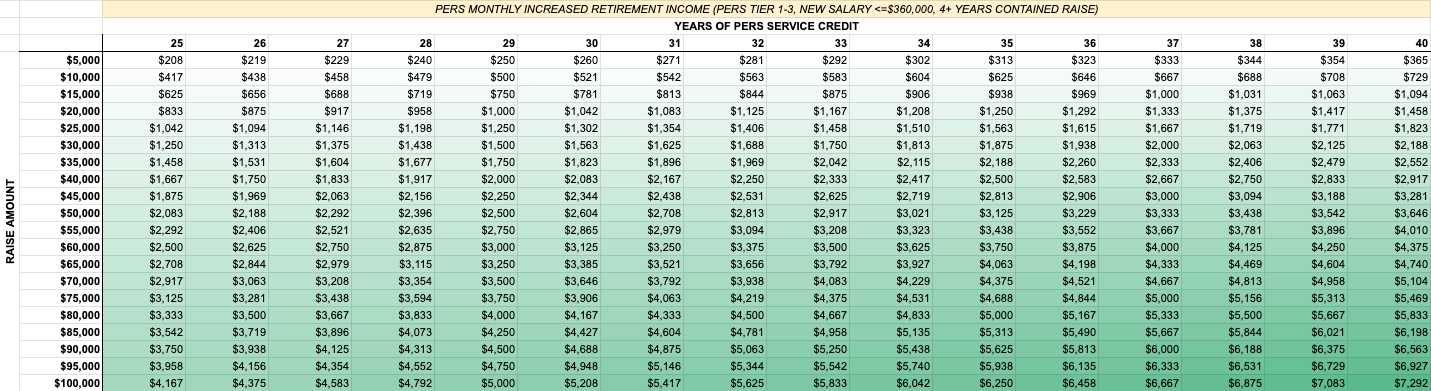
Increase in Monthly PERS Pension from Holding Promotion 4+ Years Across Various Raise Amounts and Total Years of Service Credit at Retirement
Key Data Insights:
For every additional year of service worked with a 4+ year raise, your monthly PERS pension increases by $10 to $198 per month across all raise amounts with the greatest increases coming at higher raise amounts.
For every additional $5,000 raise earned, your monthly pension increases by $208 to $365 per month across years of service credit with the highest increases coming at higher years of service credit.
Raises on the margin have a larger impact on monthly pension increases than years of service credit at retirement.
Example: $25,000 Raise Held for 4+ Years Prior to Retirement
Here’s how much that raise could increase your monthly PERS pension:
25 years of service credit - $1,042 more per month
30 years of service credit - $1,302 more per month
35 years of service credit - $1,563 more per month
40 years of service credit - $1,823 more per month
Those numbers are only for the pension increase tied to the raise itself. They do not include the value of working an extra year, which carries a separate value in and of itself.
Table 2: Monthly Pension Increase – 3 Years Holding Promotion (75% Impact)
When you hold a promotion or pay raise for 3 years prior to retirement, 75% of the raise amount is reflected in your highest four average compensation calculation. Here are the results:
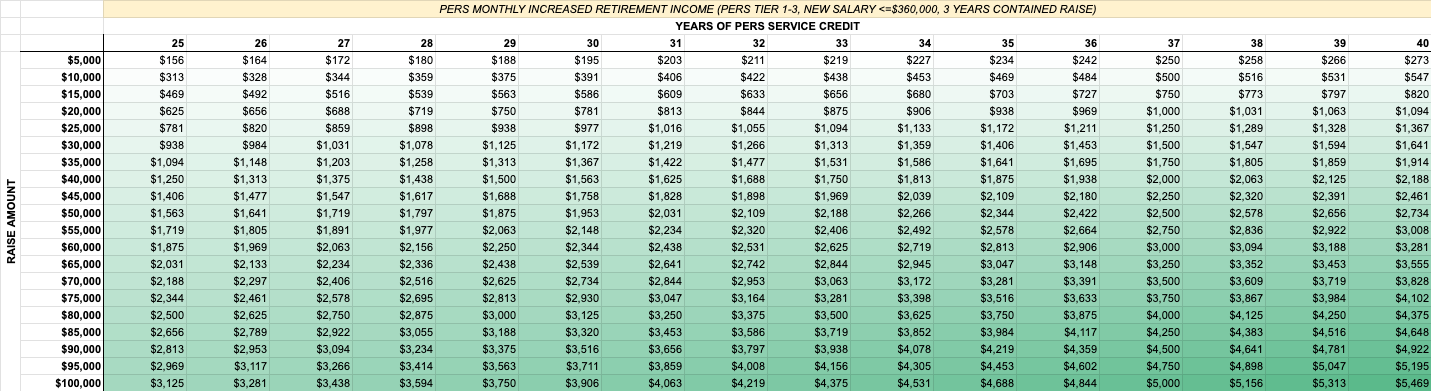
Increase in Monthly PERS Pension from Holding Promotion 3 Years Across Various Raise Amounts and Total Years of Service Credit at Retirement
Example: $25,000 Raise Held for 3 Years Prior to Retirement
Here’s how much that raise could increase your monthly PERS pension:
25 years of service credit - $781 more per month
30 years of service credit - $977more per month
35 years of service credit - $1,172 more per month
40 years of service credit - $1,367 more per month
Those numbers are only for the pension increase tied to the raise itself. They do not include the value of working an extra year, which carries a separate value in and of itself.
Table 3: Monthly Pension Increase – 2 Years Contained Raise (50% Impact)
When you hold a promotion or pay raise for 2 years prior to retirement, 50% of the raise amount is reflected in your highest four average compensation calculation. Here are the results:
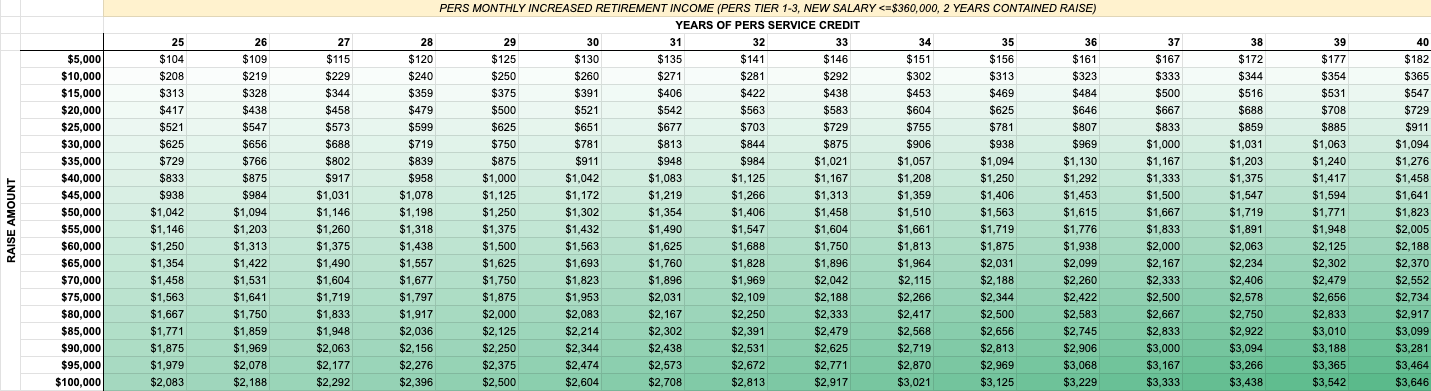
Increase in Monthly PERS Pension from Holding Promotion 2 Years Across Various Raise Amounts and Total Years of Service Credit at Retirement
Example: $25,000 Raise Held for 2 Years Prior to Retirement
Here’s how much that raise could increase your monthly PERS pension:
25 years of service credit - $521 more per month
30 years of service credit - $651more per month
35 years of service credit - $781 more per month
40 years of service credit - $911 more per month
Those numbers are only for the pension increase tied to the raise itself. They do not include the value of working an extra year, which carries a separate value in and of itself.
Table 4: Monthly Pension Increase – 1 Year Contained Raise or One-Time Bonus (25% Impact)
When you hold a promotion or pay raise for 1 year prior to retirement, 25% of the raise amount is reflected in your highest four average compensation calculation. Here are the results:
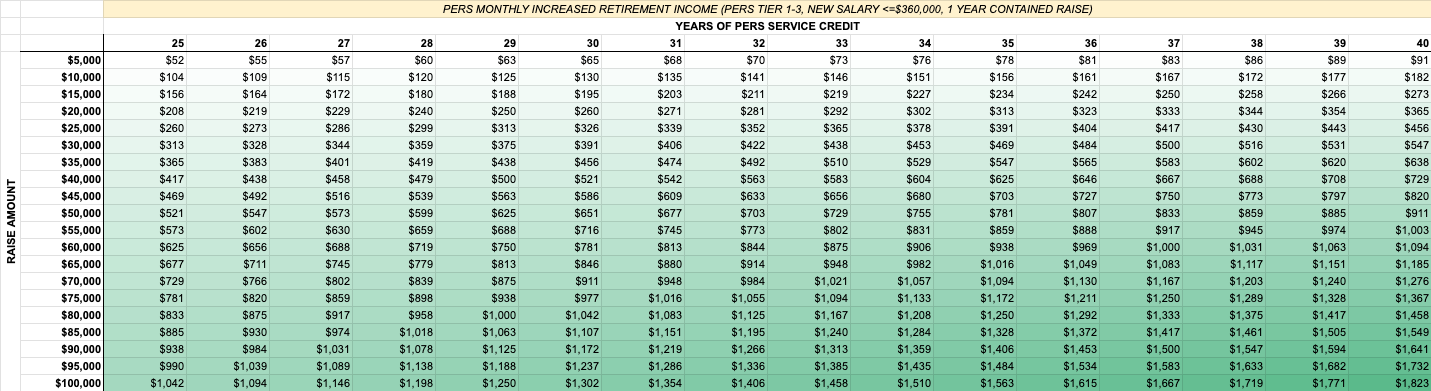
Increase in Monthly PERS Pension from Holding Promotion 1 Year Across Various Raise Amounts and Total Years of Service Credit at Retirement
Example: $25,000 Raise Held for 1 Year Prior to Retirement
Here’s how much that raise could increase your monthly PERS pension:
25 years of service credit - $260 more per month
30 years of service credit - $326more per month
35 years of service credit - $391 more per month
40 years of service credit - $456 more per month
Those numbers are only for the pension increase tied to the raise itself. They do not include the value of working an extra year, which carries a separate value in and of itself.
How to Decide Whether a Late-Career Promotion Is Worth It
A promotion or additional-duty assignment is not just a financial consideration. You also have non-financial considerations. More responsibility, longer hours, and/or added stress may come with the promotion.
One way to think about the decision is to compare the added financial value of the raise with the added non-financial costs of the new role:
Financial upside - How much will your pension and Social Security increase?
Time horizon - How long will you hold the role before retiring?
Workload - Does your current stage of life allow for increased hours?
Stress - Is the added stress something you have capacity for now?
If you are only one year from retirement, the benefit may still be worthwhile, but it will be much smaller than if you can keep the higher salary for three or four years. On the flip side, if this promotion puts you at the pinnacle of your career (i.e., President, Dean, School Superintendent, Head Coach, Public Official, etc.) really think hard about how early in your career you want to pursue this opportunity.
Frequently Asked Questions
How does a late-career raise affect my Mississippi PERS pension?
Answer: A late-career raise can increase your pension if the higher salary is included in your highest four average compensation. The longer you earn the higher pay before retirement and the greater your years of service credit at retirement, the larger the pension increase is likely to be.
Does a late-career promotion increase my Social Security retirement income too?
Answer: While this analysis focuses specifically on the Mississippi PERS pension formula, higher salary earnings can potentially increase your Social Security Average Indexed Monthly Earnings (AIME) if the new salary replaces lower-earning years in your top 35 lifetime working years. However, because Social Security averages your earnings over 35 years versus 4 years with PERS, a promotion late in your career has a much smaller percentage impact on Social Security than on your PERS pension.
Do one-time bonuses or merit payments count toward my PERS pension?
Answer: Generally, no. Under PERS Regulation 65, performance-based incentive payments paid to employees on or after July 1, 2013 are excluded from earned compensation as that term is defined in MS 25-11-103(k).
What if I select a different retirement option instead of the Maximum Retirement Allowance Option?
Answer: The numbers in these tables assume selection of the Maximum Retirement Allowance Option. If you select another option, your monthly pension will still increase as a result of a promotion or raise late in your career, though the increase in your PERS pension could be lower and will depend on calculations PERS makes based on your unique circumstances.
How can I receive an individual projection for my personal situation including Social Security?
Answer: The figures in this post represent generalized educational modeling across standardized service tiers. To receive an exact individual projection tailored to your personal service history, earned compensation, and retirement date, you can schedule an introduction with our financial planning team.
Final Thoughts
Deciding whether to take on a promotion or leadership role late in your career involves balancing immediate job demands against guaranteed, lifelong financial benefits. Because PERS pension checks are paid every month for life and include cost-of-living adjustments (COLA), even a modest pay raise held for 2 to 4 years can generate thousands of dollars in additional retirement income per year.
Disclaimer: This post is for educational and informational purposes only and is not to be construed as personal financial, investment, tax, or legal advice. We cannot guarantee the accuracy in the future as federal and state laws change. Always consult a professional for personal advice specific to your situation.
